Why Seasonal Clay Movement Can Vary Across a House
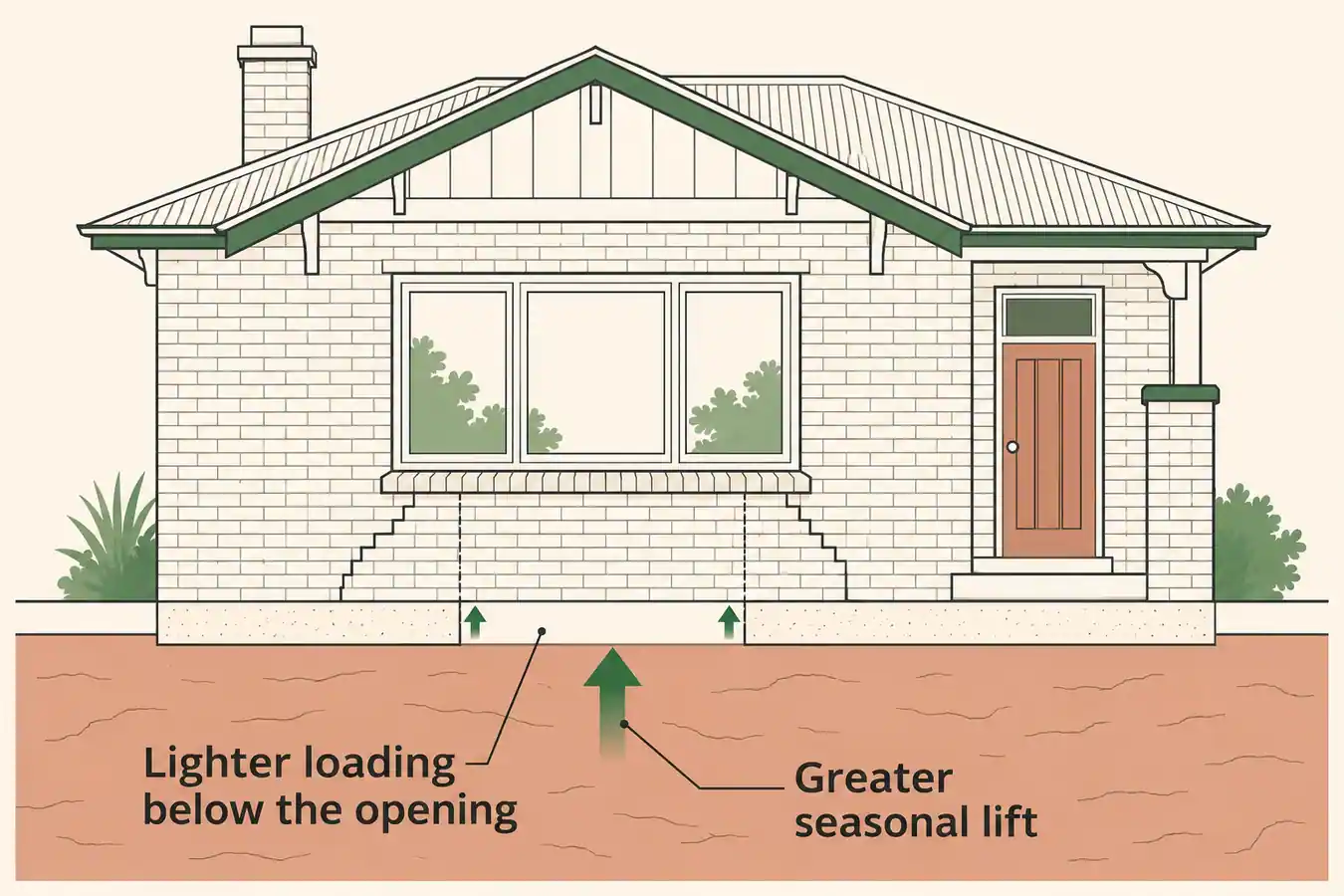
Seasonal clay movement can vary across one house because moisture changes are uneven and different parts put different loads on the soil. Under a wide opening, supporting clay may carry less weight than it does beside the jambs, giving swelling ground more opportunity to lift that portion. Elsewhere the same season can produce a different response. An under-window crack can be consistent with this arrangement without proving it or showing that it is harmless.
Why an opening changes what the soil carries
The load from wall or roof above a wide opening passes through a lintel or other support into the masonry at the sides. In Figure 1, it does not spread back under the opening before reaching the foundation. Less weight bears on the ground at the centre than beside the opening. If the clay swells as it wets, the lightly loaded region can rise farther, and cracking can appear under the centre. Actual walls may have different footings or load paths.
Figure 1 shows two forms of the opening. A window leaves a short wall beneath its sill, while the door-like opening reaches the floor line. The central cracks are related to how the load reaches the support below, not the shape of the opening or a diagnostic crack width. Lintel deflection above or poor bearing at one side would raise different questions, even if the visible symptoms were close to the window.
Why bearing capacity and movement are not the same
A footing can spread load into clay that carries it adequately yet still move as the clay dries or rewets. Soil response can vary beneath different parts in the same weather. Loads and structural stiffness can also restrain some parts more than others. Establish what supports the relevant footing and how the load reaches it before inferring a foundation defect from the crack pattern.
Compare the starting conditions as well as the season. Clay that normally rewets can rise again after a dry period. A deeper moisture deficit can recover more gradually after an influence changes, such as removal of trees before construction or around an existing building. A nearby stump or a crack noticed after rain does not establish moisture below the opening or how long the movement has been developing. Do not alter watering to test the explanation.
A single-storey portion also loads its foundation differently from a taller adjoining part. The height contrast may help explain why relative movement concentrates at their junction, but first check whether the foundations and ground also change there. The same account cannot be assumed to fit a tall original wall tied to a later lightweight addition. If a recurring break is in an exterior junction, weather resistance is a separate performance question even where the movement appears cyclic rather than progressive. Repointing can close the visible line temporarily while leaving the two parts to move differently in the next cycle.
Evidence that distinguishes a cycle from a developing change
Compare the affected area with one that has different load or support. A close-up below a sill may miss the full span, a changed beam or a nearby change of construction. Dated wide views and repeat readings can show whether the opening partly closes again or leaves a lasting shift. Recurrence after repair alone does not prove a seasonal cycle. Persistent distortion or changes involving neighbouring supports need a wider explanation than the idealised arrangement in Figure 1.
For example, a crack below one wide window that varies while the surrounding wall geometry remains much the same presents a different first question from a line that appears with a persistent slope across the same part of the house. Ask what the evidence says about the direction and distribution of movement, and whether a comparison of building levels would help. Consider any changes to loads, drainage or vegetation that could distinguish moisture cycling from a continuing change in support.
Ask the engineer to explain which loads and moisture conditions are thought to differ across the area, which facts establish those differences and whether the building response matches them. A case diagram is a way to understand why one part might lift more readily, not a finding of stability. If movement is progressing or a wall becomes loose or appears unstable, seek professional advice without waiting for another season and obtain emergency help when danger is immediate.