What do tribunal figures show about higher-value building and property disputes?
In one state's Building and Property List, new applications in the over-$100,000 category increased in 2024-25 while total new applications fell. That is a change in the mix of applications, not proof that average repair costs or homeowner awards increased.
More applications in the top band, fewer overall
The top band covers claims of more than $100,000. It rose from 284 new applications in 2023-24 to 330 in 2024-25, an increase of 46, or about 16.2%. Total new applications fell from 2,399 to 2,074. The no-value group fell from 1,254 to 1,013, and counts also fell in the other two stated-value bands. Figure 1 compares counts and mix, not the average claim amount.
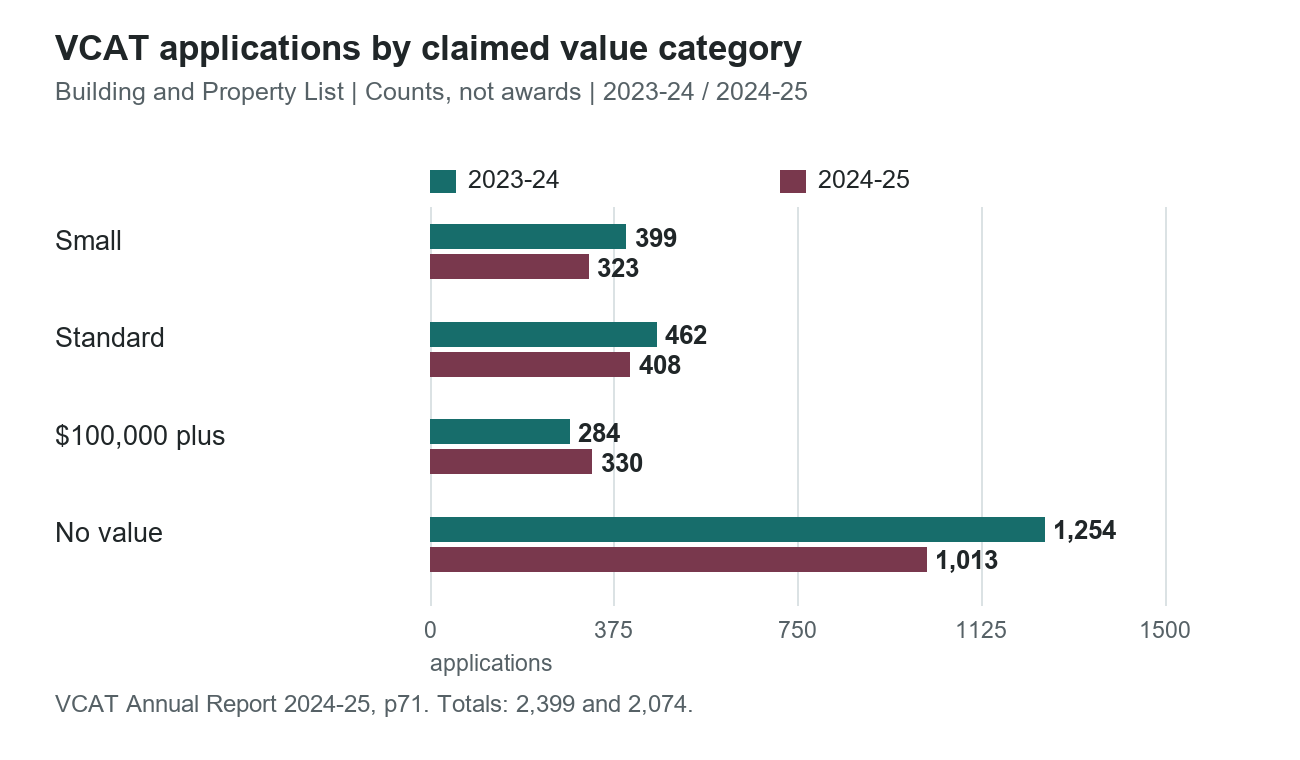
The list includes domestic and commercial building disputes, warranty insurance, co-owned land, retail and commercial leases and disputes about unreasonable water flow. It is not a register of residential defects. Where a claim amount was recorded, the band reflects what was claimed, not what the tribunal awarded, what the parties settled for or what the repairs cost.
What an open-ended band cannot tell you
Knowing that an application is in the top band does not tell you where it sits above the threshold. The band could contain similar amounts or a wide spread without changing the shape of the bar. Likewise, the no-value band does not provide a set of zero-dollar awards or claims to use in a calculation. The published counts do not give the underlying dollar amounts needed for a mean. Moving cases into a higher band would affect the mix, but the two totals alone do not show whether any particular dispute changed amount.
As a share of all new list applications, the top band rose from about 11.8% to 15.9%, calculated as 284 divided by 2,399 and 330 divided by 2,074. Both denominators include all listed matter types and no-value applications. The comparison measures the composition of the list, not the proportion of building disputes that resulted in a high award.
Two years on the same reporting basis do not establish a longer-term trend. New applications are also not the same as finalised or pending matters. Over the comparison period there were more finalisations and fewer pending cases, alongside staffing pressure affecting multi-day hearings. That describes workload and capacity rather than the likely timetable or outcome of an individual matter.
At a property, establish which work the amount represents
A contractor's number is meaningful only in the context of the work and quantities priced. A proposal may cover access, investigation, removal, repair and reinstatement, or only some of them. If the cause or extent is unsettled, a quote may depend on a stated assumption about the condition behind a finish. A firm rate for a listed item and a provisional allowance pending inspection have different evidential value.
Compare what the technical report says is damaged with what the quote proposes to do. If the report confirms one section of a wall is affected but the quote includes the whole room, ask what needs the wider work: greater damage extent, access, continuity of the repair or simply a more extensive finish. It is possible for the proposed work to go beyond visibly damaged material for a reason, but that reason should be stated. The technical and cost comparison does not determine what is legally recoverable.
Example: two prices for work at the same wall
Suppose a report identifies a recurring stain on a wall. One quote covers preparing and repainting the surface. Another includes opening the lining, checking where water entered, repairing a confirmed source if found, and reinstating the room. The larger price does not show that the same job was priced higher. It describes additional steps and may include conditional work the first quote did not attempt to price.
Compare the break-up of the proposed work and the assumptions behind it. In this example, an assessor might first establish whether the leak source can be verified without opening the whole wall. A reliable technical scope can then say what will actually be opened, what work is contingent on a finding and how the area will be made good. That makes prices comparable without pretending a still-hidden condition is known.
Use the date and version with each combination of scope and price. If the work was revised after a further inspection, an older lump sum answers a different brief. Substituting quantities from a later revision into that quote produces a calculated figure, not a price the contractor offered. Keep the distinction visible if both figures are discussed in a dispute.
Use the tribunal chart as context, not as case evidence
Figure 1 shows how new matters in the list were grouped. It does not tell an owner whether a proposed case is likely to succeed, whether it concerns a higher-value residential defect or whether a quote is reasonable.
For a particular matter, the more useful comparison is the agreed work, the evidence of actual condition and the documented cost of the repair claimed. If that comparison leaves a technical issue unresolved, make it explicit for professional assessment. Keep the questions of entitlement and tribunal procedure separate from the engineering and cost evidence.