Protecting Buildings While Keeping the Benefits of Trees
You can often protect a building and retain a valued tree if the intervention addresses the actual way the tree and structure interact. Direct pressure on a small garden wall calls for a different response from shrinkage of clay beneath a house footing. Establish which mechanism, if either, the evidence supports before comparing work on the tree with options to adapt the structure or manage the ground.
Is the tree moving the structure directly or changing its support?
A root pressing against a wall or lifting paving can create displacement close to the point of contact. That is a mechanical interaction and does not require shrinkable clay. By contrast, when a tree withdraws water from responsive clay, the ground can shrink over a broader zone and the building can distort where its support moves unevenly. In the second case, simply moving a wall away from the visible root does not necessarily alter the moisture conditions below its foundation.
Locate the affected structure, its support and the tree or trees. A root exposed in an excavation can show a route and may be identified by sampling, but it does not measure moisture uptake. Distinguish direct contact, shrinkage and interaction with a service. An arborist can assess likely growth and condition; the building and ground evidence must connect that to the damage. Historical root spread records are not a risk calculation for the next property.
Compare what each option does and what it leaves behind
Retention can preserve shade, cooling and amenity while avoiding unnecessary removal of a tree that was not causing the problem. These benefits need to be weighed against the cost and feasibility of the structural work and ongoing tree care. A low first cost does not establish a low total cost if repeated pruning, access or renewed repairs are required. Likewise, a more involved structural option may preserve a high-value tree but may not be proportionate for every wall or site.
Where a tree contributes to seasonal drying, an arboricultural management option may change the amount of water withdrawn. It needs a realistic prospect of limiting the relevant movement through regrowth and maintenance. Where clay remains deeply dried across wet periods, reducing or removing the tree's influence can instead lead to swelling as moisture returns. A healthy tree and a viable retention option need assessing together; neither retention nor removal is an automatic structural solution. Added building work needs to deal with the expected support conditions, not simply move an obstruction shown on the garden plan.
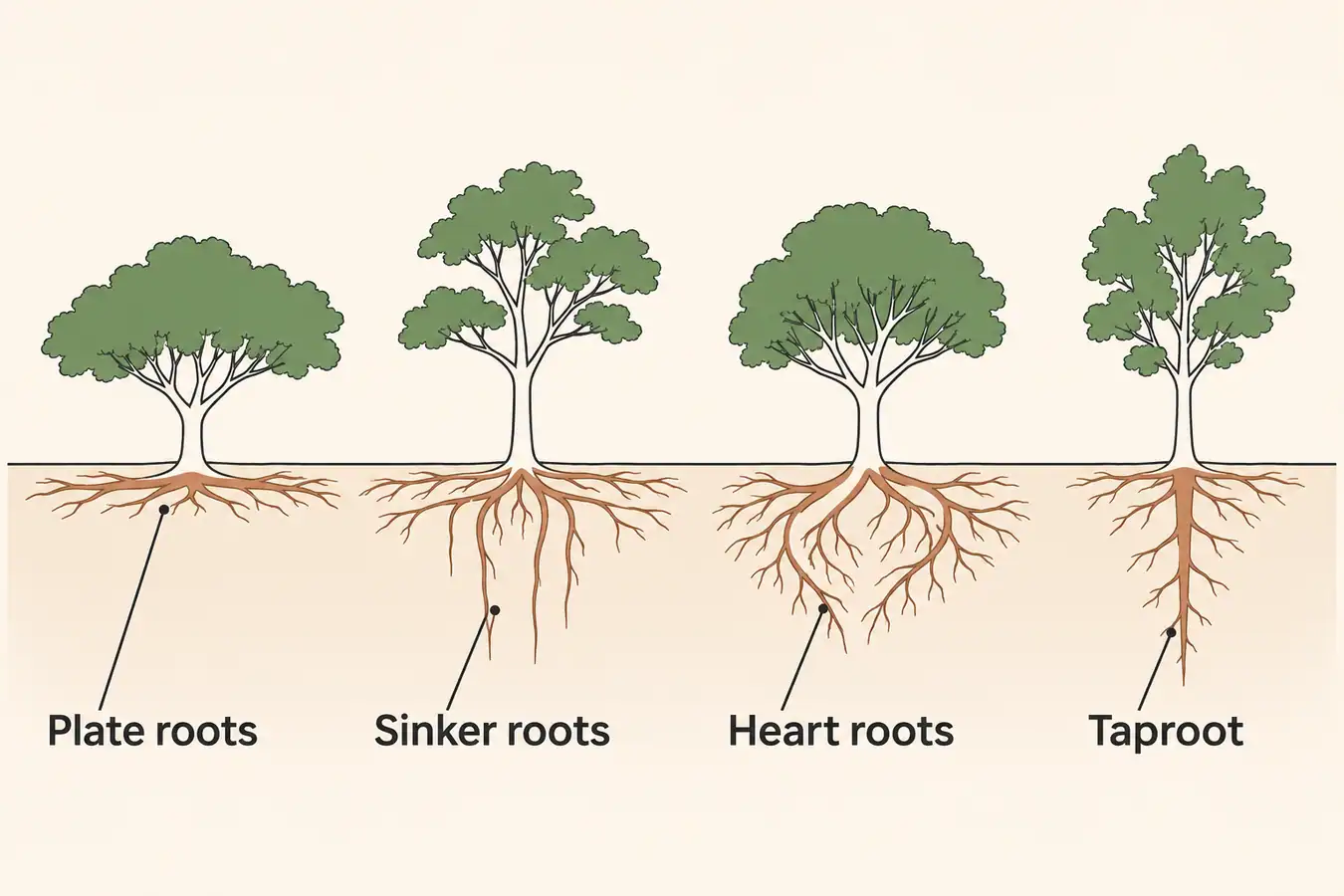
Can a small structure be designed clear of root growth?
Figure 1 shows possible root arrangements, not the location of roots at a particular wall. If roots and a small boundary wall conflict, a fence infill can interrupt the rigid masonry. A lintel spanning the area is another option if suitable support is available clear of the roots. Both alter the wall rather than assume the tree must go. Have the clearance, support and effect on the tree assessed. A small boundary-wall detail is not a house footing design.
Roots can grow around, under or even over a buried barrier and return beyond it. Services can interrupt the barrier, and groundwater can flow differently along it. Installing one can cut roots that stabilise the tree. Do not assume a barrier or severing roots will preserve stability or protect the footing. Compare options that avoid excavation through the root area.
Where the actual problem is roots entering an already defective drain, repairing the service may address that interaction without treating the tree. That option still depends on checking whether the tree is implicated in any separate movement of the ground supporting the building.
Can the chosen arrangement be managed over time?
Agree what success would look like for the actual mechanism. For direct contact, the question may be whether clearance and the stability of the altered small structure can be maintained. For moisture-related movement, it may be whether comparable building levels show that movement has been reduced without introducing a damaging recovery trend. Record the intervention and the assumptions on which the outcome depends, such as continued tree management. A recommendation based on repeat treatment is not complete if nobody can arrange it or verify how the building has responded.
Check what local approvals are needed before work on a tree or the ground. Identify which tree or part of the structure needs action and leave unrelated trees out of the work. If installing the proposed detail would unacceptably affect the tree or neighbouring support, choose a different approach.
What a proportionate proposal should explain
- The evidence linking the particular tree to contact or changing foundation support.
- How the option treats that mechanism, including effects on the tree, ground and occupied property.
- Which support or root conditions must be established before design.
- What future management or comparison is needed to see whether the option is still performing.