New Loads on Old Ground After Building Alterations
An alteration can increase the load on old ground without adding floor area. A beam over a new opening redirects load that was previously spread along a wall into its ends. An extension adds load to ground with a different history from that beneath the original building. Either arrangement can leave one part moving relative to another. Before attributing a crack to the alteration, trace the changed load all the way to the actual support.
Follow the load below the new opening
When a section of loadbearing wall is replaced by a beam, the beam may be quite adequate while the support beneath one end is the problem. The beam transfers load at the two bearings. The masonry or post below then has to carry that load to a footing, which passes it into the ground. A strip footing that once received load along much of its length can experience a more concentrated load beneath that end. Whether that produces additional settlement depends on the geometry of the load path, the capacity of the support and the ground beneath it.
Distinguish a beam that bends between its bearings from a bearing that drops with the structure below. Both can affect the shape of the opening or damage finishes. The checks are different: one concerns the member and its restraint and loading, the other concerns load transfer through and below the support. Look for effects in adjacent rooms and below the opening rather than treating damage at its head as proof of one or the other.
Identify what was taken out, what put the load back and where the new bearings were formed. A dated plan may show a proposed post, pad or bearing that is no longer visible after completion. Have the engineer establish which detail was installed. Alteration dates establish which arrangement existed before the visible change, not whether the proposed design or the building work caused it.
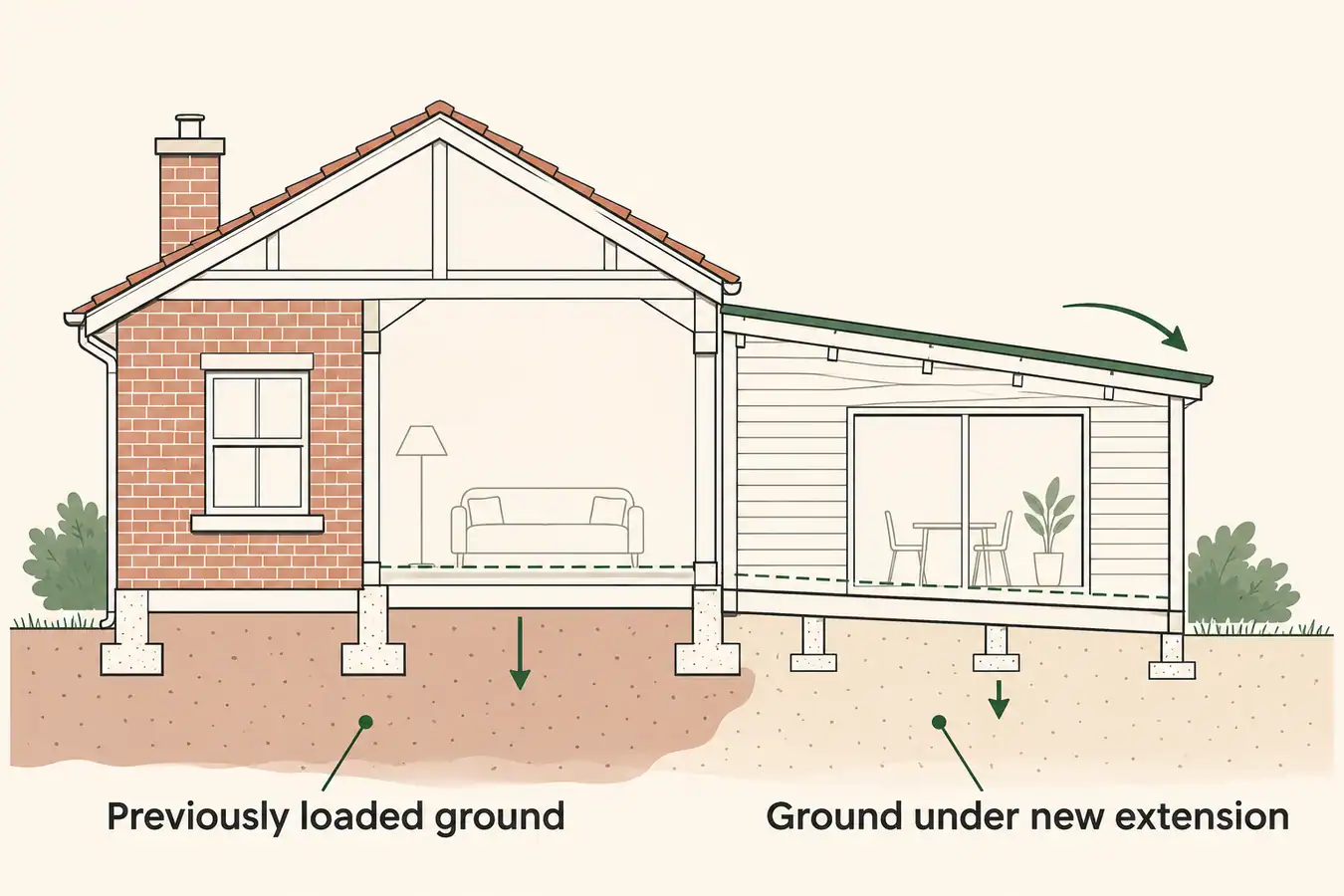
The addition and original house load different ground
Extra compression under new load is different from movement caused by a change in the ground, such as clay shrinkage, although both can occur over the same period. Ground nearer an older building may already have compressed under its load. The new work can therefore settle by different amounts between its ends and rotate, rather than dropping as a level block. A crack at the join can reflect that rotation.
Unequal loads can also arise where connected portions have different numbers of storeys, even without an extension. On compressible ground the heavier section may settle more. That depends on the load and support arrangement, not a rule that the taller or newer part always moves farther.
Figure 1 shows the previously compressed zone beneath the original building. As the addition applies its load, the new support close to that zone can respond differently from the ground farther under the extension. That difference can produce rotation during settlement.
Figure 1 deals with the initial response to new load, not the actual footing arrangement of every extension. An addition may bear at a different depth, in a different layer or where moisture varies differently. Seasonal movement can continue after the initial adjustment slows. Sustained or accelerating movement that does not fit the expected load response calls for another explanation; construction age alone does not provide a deadline for settlement.
What would distinguish an initial adjustment from ongoing change?
Compare the sequence of demolition, installation of the new supports, addition of loads and discovery of the issue. Record dates for observations you can verify and identify gaps. An older picture showing an unchanged line before a beam was installed weakens an explanation based on that beam for initial cracking, but could still leave a later change open. A crack that appears at a junction just after a new load is applied is a lead; the displacement and support evidence still need to fit.
Ask the assessor which points would distinguish continuing settlement of a bearing, change at the extension junction or a seasonal ground response. A single level survey describes present geometry. Comparable records over time describe change in that geometry, not automatically its cause. If a report finds the added load significant, it should identify which support receives that load and what evidence shows the support is moving or inadequate. That is a different conclusion from saying the alteration happened recently.
This matters for repair. A flexible treatment at a known junction can answer a local finish or water-entry problem without improving a deficient bearing. Equally, an old, unchanged line does not justify extensive foundation work simply because a beam now spans the nearby opening. Match the remedy to the demonstrated support or joint problem.
Obtain prompt assessment of progressive distortion or signs that a support has shifted. Keep out if there is apparent immediate instability and obtain emergency help where needed. Leave foundation exposure to an investigation that accounts for the support it is meant to examine.