How Are Paint Blemishes and Coating Failure Assessed?
Assess paint in two ways: was the finish visibly blemished when applied, and did the coating fail within the durability period for that product? A run at handover and flaking that develops with use are different observations. Blistering can matter to either question, so note when it became visible and what is known about the underlying surface.
For appearance, the Building and Plumbing Commission's Guide to Standards and Tolerances 2026 uses normal viewing conditions and non-critical, diffused light. A plaster joint can stand out with a lamp held against the wall and be much less apparent in the room's ordinary lighting. Use a close-up to locate the feature, not as a substitute for the normal view. Identify the plane or edge affected and compare the finish elsewhere on the same element.
Is the mark on the applied finish or in what it covers?
Section 16.2 (surface finish of paintwork) lists examples of visible application problems: runs or sags, wrinkles, dust, bare or thinly covered areas, colour variation, cracks, coarse brushing or sanding marks, blistering and uneven gloss. It also addresses excessive paint extending onto fittings, trim, skirting, architraves, glazing and similar finished edges when normally visible. A run within a wall field and paint carried onto the glass are separate observations. Their positions show whether the enquiry is chiefly about the appearance of the coating, the edge between finishes or both.
The finish provisions extend to what remains visible through paint or stain. Section 16.3 (nail and screw fixings) addresses visible fixings or an unfilled depression left by a fixing. Section 16.4 (natural features and damage visible through finishes) addresses normally visible gum pockets, splits and bleeding sap as well as mechanical damage, holes and other unfilled depressions. A painted dimple can originate in preparation or at the substrate; being covered in paint does not make it invisible or remove it from the comparison. No cause should be assumed solely because a particular mark resembles one of the examples.
A raised line following a plasterboard joint or a row of visible screw heads can also raise a lining question. Joint peaking, visible jointing and fixings showing through are distinct from brush or roller marks. Locate the line in relation to the board joint. The lining and the applied coating can both need assessment without being the same finding.
Choose the durability row for the actual coating
Section 16.1 (standard of painting) refers to the manufacturer's instructions and the recommendations of AS/NZS 2311, and calls for durability suited to the conditions and wear. Find the product or specification rather than guessing from its gloss or colour. For example, a clear-looking finish on outside timber and a semitransparent stain can be confused in a photograph. The row in the durability table depends on the coating, not on the observer's description of how much timber grain is visible.
Section 16.5 (paint durability) treats lifting, blistering, flaking, fading or similar failure within the minimum period for the coating as outside tolerance. Count from completion. Figure 1 lists separate periods for exterior acrylic, enamel and semitransparent stains, as well as interior finishes. If the coating is unknown, the applicable period is unresolved; do not select one by its appearance.
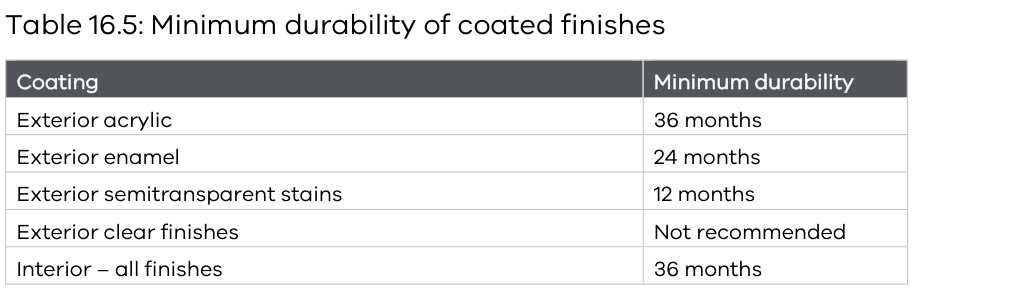
Exterior clear finishes have no numeric minimum in Figure 1. 'Not recommended' does not mean a zero-month benchmark and does not decide warranty or responsibility. Nor does a durability period explain what made the paint lift. Timing can show that a confirmed coating faded within its period, but specification and exposure still matter when deciding whether an isolated repair is enough.
Suppose exterior coating failure is first observed 18 months after completion. That is within the 24 months for exterior enamel in Figure 1, but beyond the 12 months for exterior semitransparent stain. The comparison depends on product and timing; a photograph alone establishes neither the product nor when failure began.
Consider a blister visible on the completion photos and another area that begins to flake later. The first can be assessed as part of the visible application; the later change makes the completion date and coating category essential to the durability enquiry. If flaking repeatedly returns at one exterior junction, ask what condition there differs from the rest of the wall before commissioning repainting. Exposure, prior preparation and what the coating was applied to are useful context. The picture and time comparison do not by themselves establish which of those factors is responsible.
Supply the product record if known, the completion and first-observed dates, and a normal-view photograph locating the affected area. Include a close detail if needed. The 2026 tolerances are advisory for domestic building work within the issuing jurisdiction. They do not determine the cause of failure or the warranty outcome.