Ground Improvement and Foundation Repairs Understanding the Difference
Ground improvement changes the material carrying a building. Foundation repair changes the support or the way load reaches the ground. Some projects need both; moving a slab back into position is a third objective that can accompany either. Ask which of those outcomes the proposal is designed to deliver and how each will be verified.
Ground treatment changes a defined part of the ground
A proposal might fill a cavity, densify loose soil or change the way a soil zone responds to water. Those are not equivalent outcomes. A material that fills a space need not compact soil outside that space. A method that improves one layer need not affect a weaker layer below it. Start with the ground profile and the location of the material that failed to provide the expected support.
If the objective is to reduce deformation under load, ask what zone must respond differently and what the investigation established about its existing condition. The verification needs to address that objective. Proof that material was delivered to the site, or even injected at the planned locations, does not itself measure the ground's response.
Foundation repair changes how loads are supported
Underpinning provides a new or altered foundation to bear the load. The design must establish how the existing wall or slab transfers load into the new work and what ground carries that load afterwards. Installing a new support nearby does not automatically engage it with the building. The connection and bearing arrangement are part of the repair, not finishing details.
Consider a wall supported on one end by a footing over poor fill. A design might bypass the affected material with a new support, instead of trying to improve the full depth of fill. Alternatively, where a suitable zone can be treated and the footing can still carry its loads, the existing load path might remain. The decision depends on what failed and what can be achieved and checked at the site.
A lift shows displacement, not completed treatment
If a slab rises during injection, that shows a level change at the measured point. It does not show that an entire cavity was filled, that load is now distributed as intended or that neighbouring supports did not move. Define the treatment zone and performance target before work, monitor movement during installation and check the result against the target. A lift survey and a ground test serve different purposes.
Before work, identify which movements are acceptable and what would make the specialist stop and review the approach. A crack opening elsewhere, or movement near a service connection, can matter even if the instrument on the target slab shows the intended lift. Do not use a demonstration lift as the only evidence of sustained support.
Conditions that can change the suitability of treatment
The ground, nearby structures and buried services constrain the work. Pressure applied in one place can move or damage something at another. An old damaged drain in a treatment zone is a specific concern, not just a drawing note. Check the plan for locating and protecting services and what the team will do if conditions differ from the investigation.
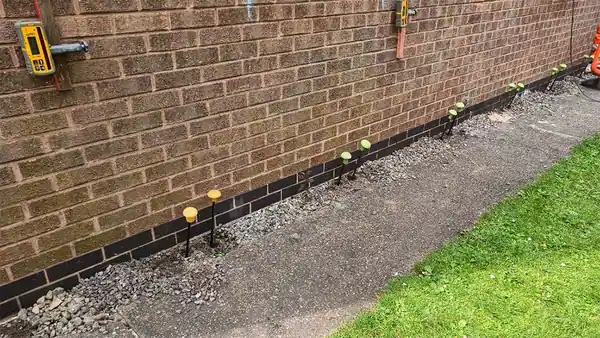
Figure 1 shows where the tubes were installed on one job. Tube positions do not show the extent reached underground or the ground response after treatment. Neither suitability nor verification can be inferred from the photograph.
Void filling, slab lifting and compaction solve different problems
A fluid grout can fill a space, whereas slab jacking is intended to raise a slab. Compaction grouting uses a stiff grout mass to displace and densify suitable loose ground. What distinguishes these methods is the intended action, not simply that each introduces material below ground. Filling a masonry core with grout is a different application again.
Compaction depends on confinement. Near a free face or the surface, ground may move rather than densify. Grout can enter buried pipes, and installation records alone can be hard to interpret. Verify where the material went and whether the treated ground meets the stated objective.
Lime treatment depends on the soil's reaction; water and saturation can affect the result. A moisture barrier works by changing water paths, not by strengthening the soil directly, and must be continuous at joints and connections. Check the result each method is intended to deliver rather than taking the name of a treatment as evidence that it worked.
Ground treatment cannot by itself repair a damaged structural connection. Underpinning does not necessarily remove the local water source or treat all surrounding soil. Where a proposal combines methods, identify what problem remains if any one package is omitted.
What an engineer should be able to verify
- The ground zone to be treated and the building elements whose supports will change.
- The intended mechanical or moisture-control result and the evidence that can verify it.
- What the movement observed during the work does and does not demonstrate.
- How services, nearby supports and unexpected conditions affect the design and verification.